

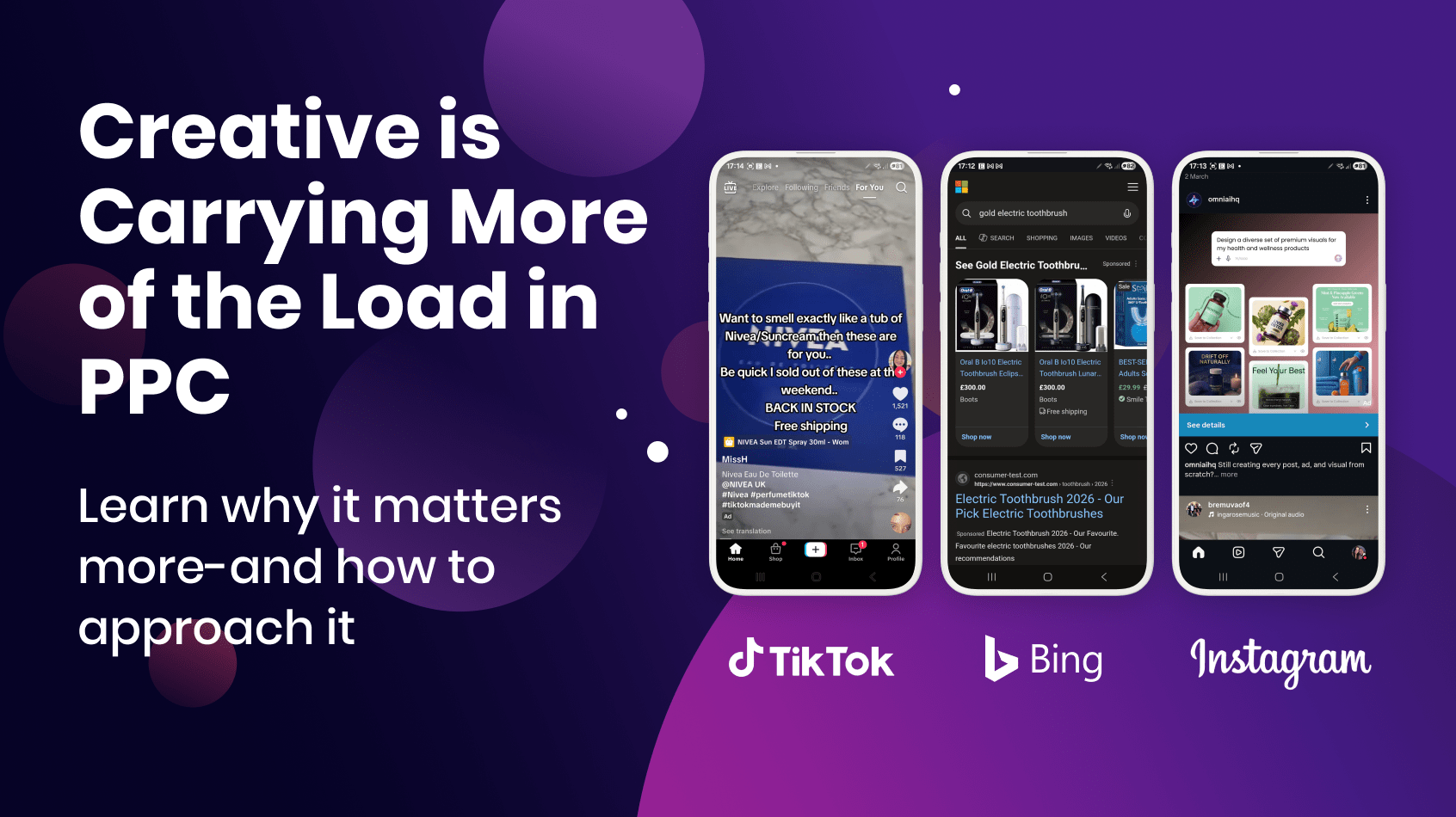
As automation reduces control in PPC, creative has become a key performance driver. Learn why it matters more-and how to approach it.
There was a time when PPC performance was driven by control. The more precisely you could define your audience, structure your campaigns, and manage bids, the better your results tended to be.
That model has gradually changed. Many of those decisions are now handled by the platforms themselves, with automation reducing the impact of manual adjustments and shifting how performance is driven.
As a result, the areas advertisers can directly influence have narrowed. And as that’s happened, the role of creative has evolved with it. It’s no longer just part of the ad or a branding layer added at the end. It has become one of the primary ways performance is influenced.
The shift from targeting to creative
For a long time, paid social in particular was built around audience precision. Advertisers invested heavily in defining segments, layering interests, and refining exclusions in order to improve efficiency.
That approach made sense when platforms offered a high degree of control and when signal loss was less of a factor. However, as privacy changes have reduced the availability of user-level data, platforms have adapted by leaning more heavily on probabilistic modelling and aggregated signals.
Both Meta and Google now encourage broader targeting approaches, allowing their systems to identify potential customers beyond predefined audience lists. In practice, this reduces the impact of manual targeting decisions and increases the importance of the inputs that remain – particularly creative and conversion data.
Why creative now carries more weight
Creative is one of the few elements that still directly influences how platforms interpret and deliver ads.
It plays several roles simultaneously:
- It acts as a signal. Platforms use engagement and interaction data to determine which users are more likely to respond to an ad
- It determines click-through behaviour, which feeds into optimisation models
- It shapes conversion intent by setting expectations before the user reaches the landing page
Research from organisations such as Nielsen, as well as studies shared by Meta, has consistently shown that creative can account for a significant proportion of performance variance in digital campaigns. While exact figures vary depending on methodology, the direction is clear: creative is not a marginal factor.
In practical terms, two campaigns with identical targeting and budgets can produce very different outcomes based purely on creative execution.
This shift is also visible in how platforms are expanding the role of creative within search environments, not just social.
Within Microsoft Advertising, formats such as Multimedia Ads and Image Extensions are designed to give advertisers more visual presence directly within the search results page. Rather than relying solely on text-based ads, these formats allow brands to occupy more space and capture attention earlier.
Multimedia Ads, for example, combine imagery with concise messaging and can appear alongside standard search ads, effectively giving advertisers multiple placements within the same auction. This increased visibility can make a noticeable difference in competitive search environments, where standing out is often the primary challenge.
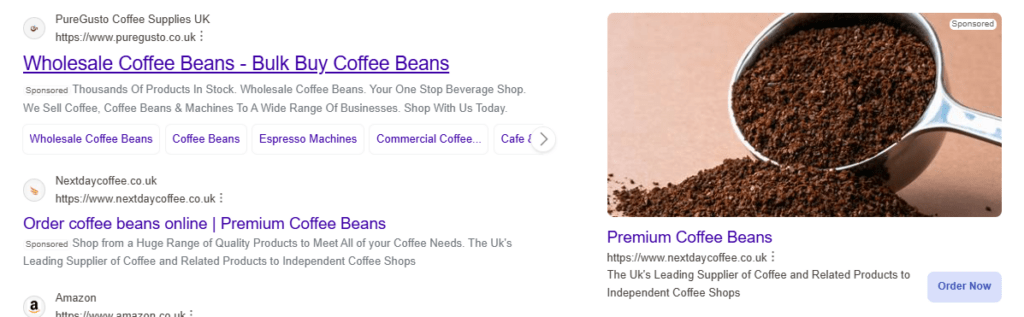
Image Extensions follow a similar principle. By adding relevant, high-quality visuals to standard search ads, they help reinforce messaging and improve engagement, particularly on mobile where visual cues play a larger role in user behaviour.

The common thread across these formats is that creative is no longer just supporting the ad – it is influencing how much space you take up, how visible you are, and how users engage with you before they even click.
In that sense, creative is not just a performance lever. It is increasingly a visibility lever as well.
The gap between importance and investment
Despite this, creative is still often treated as a secondary consideration.
It’s common to see accounts where:
- A small number of creatives are expected to sustain performance over long periods
- Creative refresh cycles are slow or inconsistent
- Testing is limited to minor variations rather than meaningful changes
- More time is spent adjusting bids or audiences than developing new assets
This imbalance is partly a legacy of how PPC has traditionally been managed. Teams are often structured around platform execution rather than creative production, and optimisation workflows tend to prioritise measurable adjustments over more subjective creative decisions.
However, as other levers become less accessible, this imbalance becomes harder to justify.
What effective creative strategy looks like now
Adapting to this shift does not necessarily require larger budgets, but it does require a different approach to how creative is developed and evaluated.
In practice, stronger-performing accounts tend to:
- Produce a higher volume of creative to allow for faster learning
Example: Instead of running 2–3 ads for weeks, brands on TikTok will test 10–15 variations of the same concept – different hooks, angles, or voiceovers – and scale what performs. - Test different angles, not just small tweaks
Example: On Instagram, changing the opening hook from “Our new product is here” to “This solved a problem I didn’t realise I had” can significantly improve performance, even if the rest of the ad stays the same. - Align creative with how users behave on each platform
Example: On Pinterest, lifestyle imagery (e.g. a fully styled living room) tends to outperform plain product shots because users are in a planning and inspiration mindset, not actively searching to buy. - Match creative to intent, not just audience
Example: A product demo or “how it works” video may perform better for colder audiences, while a testimonial or offer-led creative works better for users already familiar with the brand. - Refresh creative regularly to avoid performance decay
Example: A high-performing Meta ad may start to decline after a few weeks due to fatigue, even if targeting and budget remain unchanged – requiring new variations to maintain performance.
Across platforms like TikTok, Instagram, and Pinterest, the pattern is consistent. Performance is less about refining targeting, and more about how well creative captures attention and aligns with user behaviour.
Importantly, creative is treated as an ongoing process rather than a one-off task. The goal is not to find a single “winning” ad, but to build a system for continuously generating and testing new ideas.

Do you have a paid media camapign ready for the World Cup? Here’s why and how to take advantage of this increased demand – read the full article here
The role of structure and data
Creative does not operate in isolation. Its impact is amplified or limited by the quality of the surrounding setup.
For example:
- Poor conversion tracking can make it difficult for platforms to learn from creative performance
- Weak landing page alignment can reduce the effectiveness of even strong ads
- Overly fragmented campaign structures can limit the volume of data available for optimisation
This is where creative and broader account strategy intersect. Strong creative can drive initial engagement, but it needs to be supported by reliable data and coherent structure to translate into sustained performance.
What this means for advertisers
The increasing importance of creative reflects a broader shift in how paid media operates.
Advertisers are moving from a model based on control and precision to one based on inputs and signals. In that model, the question is less about how tightly you can define your audience, and more about how effectively you can communicate with it.
That has implications beyond campaign setup. It affects how teams are structured, how budgets are allocated, and how success is measured.
For many organisations, the constraint is no longer access to platform features, but the ability to produce and iterate on creative at the pace required.
Final thought
As automation continues to absorb more of the traditional optimisation levers, creative is becoming one of the last areas where advertisers can exert meaningful influence over performance.
That doesn’t make it easier. If anything, it shifts the challenge.
Because improving creative is less about adjusting settings and more about understanding messaging, audience behaviour, and iteration at scale.
And in a landscape where many accounts are structurally similar, that is often where the real difference is made.
Sign up to Adzooma and take control of every platform from one place – no switching tabs, no missed opportunities. Sign up free today!