

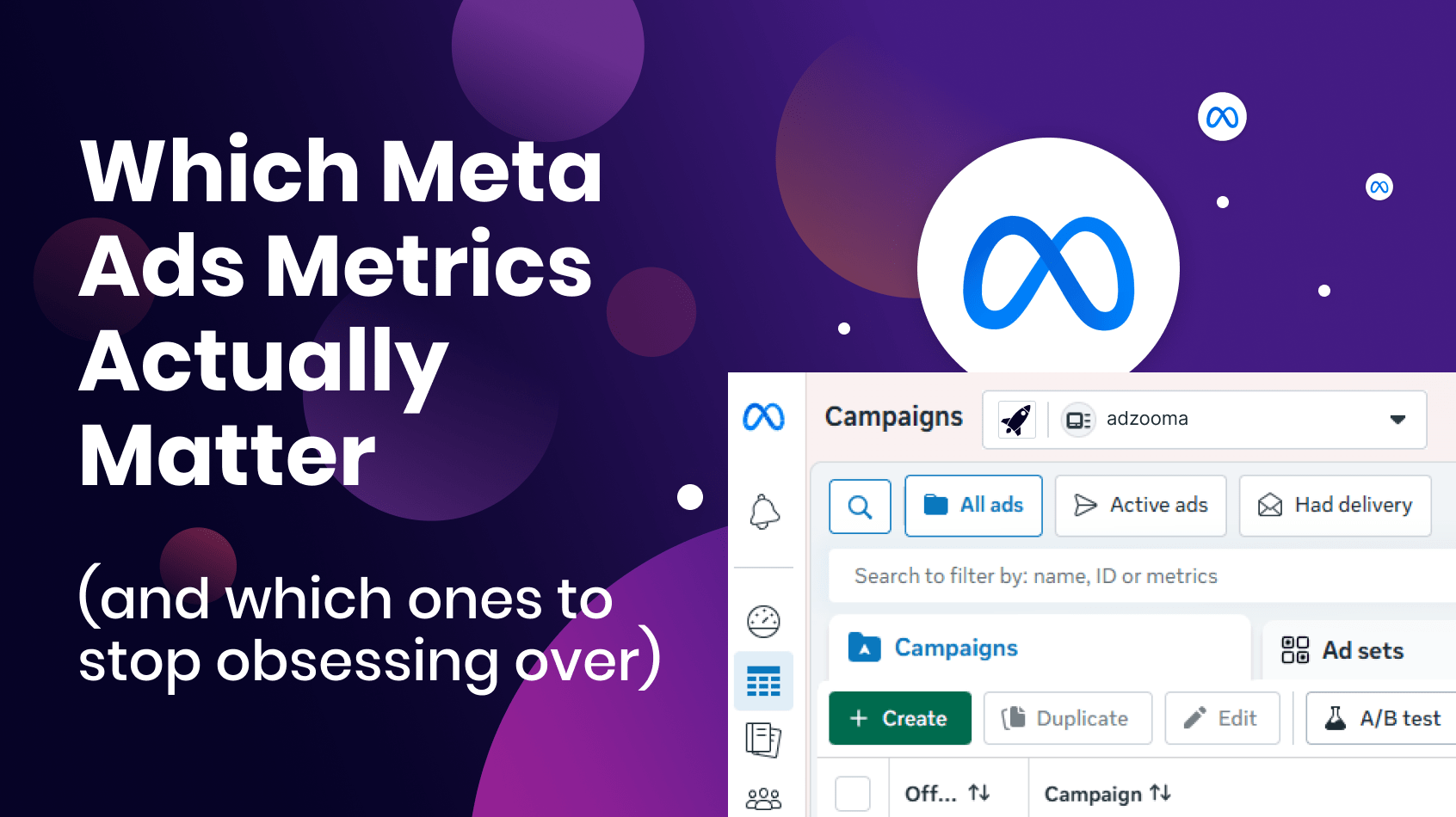
Meta Ads metrics can be a minefield. We discuss which Facebook Ads KPIs matter for campaign optimisation, when to adjust CPM and CPA, and how to avoid overreacting to performance fluctuations.
Ever stared at a Meta Ads dashboard, wondering which number actually deserves your attention?
You’re far from alone.
Meta doesn’t give you data. It gives you a firehose. CPMs climbing. CTR dipping. Frequency creeping up like a threat you can’t quite name. CPC holding steady while cost per conversion does… something. And your client wants answers by morning.
Here’s the thing: most campaigns don’t fail because you missed a metric. They fail because you optimized for the wrong one. You chased a 2% CTR improvement while your actual problem was bleeding out three columns to the right. Or you panicked over a CPM spike that literally didn’t matter.
The agencies winning on Meta right now? They’re not watching more numbers. They’re watching the right ones – and they know the difference.
The Common Mistake: Treating Every Metric as a Signal
It’s very easy to assume that if a number changes, something must be wrong. A CPM goes up. CTR dips for a day. Results slow slightly. The instinct is to tweak, pause, or restructure.
And now you’ve got a bigger problem than the CPM spike—you’ve got no idea what’s actually driving performance, because you’ve changed three variables while the algorithm was still learning.
Meta fluctuates. Daily. Hourly, sometimes. Auction dynamics shift. Audience saturation ebbs and flows. A competitor dumps budget on a Friday. None of that means your campaign is broken.
But when every tremor feels like an earthquake, you stop optimizing. You start firefighting. And firefighting doesn’t scale, doesn’t learn, and certainly doesn’t impress clients when you can’t explain why you changed everything twice in four days.
The Metrics That Actually Matter
There’s no magic dashboard number that tells you everything. But some metrics are weight-bearing walls. Others are just wallpaper.
Here’s what actually moves the needle when you’re deciding whether to scale, hold, or kill a campaign:
Results. Not impressions. Not clicks. The thing your client is paying for. If your goal is leads, track leads. If it’s purchases, track purchases. Sounds obvious, but you’d be surprised how many audits we’ve seen where someone’s optimizing CTR on a campaign built for conversions.
Cost per result – over time, not over Tuesday. A bad day doesn’t mean the campaign’s toast. A bad week might. Check your CPAs across 7–14 days minimum. If the trend line’s creeping up while volume stays flat, that’s your signal. One spike after the weekend? That’s noise.
Spend pacing and delivery. If Meta’s not spending your budget, it’s telling you something. Either your targeting’s too narrow, your creative’s fagged out, or your bid strategy’s handcuffing the algorithm. Underdelivery isn’t a metric most people check first, but it’s often the reason everything else looks wrong.
These three don’t work solo. They’re a system. Conversions holding steady + CPA stable + spend flowing normally = your campaign’s fine, even if your CTR dipped or frequency ticked up to 2.4.
But if conversions are flat, CPA’s rising, and spend’s dropping off? Now you’ve got a pattern worth acting on.
The Metrics That Make You Panic for No Reason
Some numbers aren’t lying to you. They’re just irrelevant.
Or worse—they look urgent when they’re actually fine, and you blow up a working campaign trying to fix them.
CPM spikes. Yes, your cost per thousand impressions jumped 22% overnight. Want to know why? Could be anything. A competitor launched. It’s Q4. It’s Monday. Apple changed something. Meta’s auction shifted because someone in Ohio increased their bid. You have almost zero control over CPM in isolation, and tanking a campaign because it went up is like cancelling your commute because gas prices rose.
What matters: whether that CPM spike is killing your CPA. If your cost per result is still healthy, the CPM is irrelevant. If CPA’s climbing with it, now you’ve got something to investigate—but the CPM itself isn’t the problem.
CTR over 48 hours. Oh, your click-through rate dropped from 2.1% to 1.8% since yesterday? Cool. That’s not a trend. That’s a Tuesday. CTR bounces based on time of day, creative fatigue that hasn’t set in yet, and which segment of your audience Meta happened to hit first. If you’re checking CTR daily and making changes based on it, you’re not optimizing—you’re guessing.
Single-day anything. One bad day is weather. Two bad days is still probably weather. Three starts to look like climate. If your client’s breathing down your neck about yesterday’s performance, show them the 7-day or 14-day view and explain that Meta’s algorithm doesn’t optimize for Wednesdays—it optimizes for windows. You should too.
These metrics aren’t useless. They’re context. They become dangerous the second you treat them like alarms.

How to Stop Knee-Jerking Your Way Through Meta
The difference between a decent PPC manager and a great one isn’t access to better data. It’s knowing when not to touch anything.
Here’s how to build that discipline:
Stop checking performance like it’s a heartbeat monitor. Open the account once, maybe twice a day. Look at 7-day windows minimum—14 if you’re running awareness or consideration campaigns. If you’re refreshing hourly and reacting to every swing, you’re not managing the account. The account is managing you. Trends emerge over days. Blips disappear over hours. Learn to tell the difference.
Change one thing. Then wait. This sounds basic, but most account chaos comes from stacking edits. You tweak the audience, update two ad creatives, and shift the bid strategy all on the same afternoon—then wonder why performance tanked. Now you don’t know which change broke it, so you change three more things trying to fix it. Stop. One variable at a time. Give it 3–5 days. Let the algorithm digest it. Then decide.
Resist the itch during learning phases. Meta tells you when a campaign or ad set is learning. That’s not a suggestion to leave it alone—it’s a warning. If you edit during learning, the clock resets. If you keep editing, it never finishes learning, and you’re stuck in permanent underperformance wondering why the platform hates you. It doesn’t hate you. You won’t let it do its job.
The goal here isn’t to go zen and ignore problems. It’s to separate signal from static. Data doesn’t mean anything until it has enough room to form a pattern. Give it that room.
Why the Best PPC Managers Watch Fewer Numbers
Here’s the paradox: the more metrics you track, the worse your decisions get.
Sounds wrong, doesn’t it? You’ve got all this data. Surely more visibility means better control. Except it doesn’t. It means more noise. More false alarms. More 3am Slack messages from your brain asking if that CTR dip means the campaign’s dying.
When you’re trying to optimize everything, you optimize nothing. Your attention fractures. You tweak one thing because CPM moved, another because frequency crept up, a third because CTR looked soft on mobile. A week later, performance is worse and you can’t pinpoint why – because you changed six variables chasing four different goals.
Now flip it. What if you only watched three metrics? Results, CPA, and spend pacing. That’s it.
Suddenly you’re not second-guessing every move. You’re not refreshing the dashboard compulsively. You know what good looks like, and you know what bad looks like, because you’ve given yourself a clean, repeatable framework. When something breaks, you spot it fast because there’s no clutter hiding the signal.
This is where a tool like Adzooma actually earns its keep. Not because it gives you more data, but because it surfaces the stuff that matters and mutes the rest. It highlights trends, not Tuesday’s weird blip. It shows you whether your CPA’s drifting over two weeks, not whether it hiccupped yesterday. It helps you make decisions like someone who knows what they’re doing, not someone drowning in dashboards at 11pm.
Confidence in PPC doesn’t come from watching everything. It comes from knowing exactly what to watch, and trusting yourself to ignore the rest.
Discover the features that are transforming performance for paid ad campaigns this year – read it here and get an edge on the competition!
The Real Skill Is Knowing What to Ignore
Meta campaigns don’t get better because you’re more vigilant. They get better because you’re more selective.
The account managers who consistently hit targets, scale profitably, and sleep through the night aren’t working harder than you. They’re not staring at more dashboards or setting more alerts. They’ve just learned something most people take years to figure out: most of what moves in your account doesn’t matter.
If your conversions are steady and your CPA’s where it should be, that CTR wobble isn’t a crisis. That CPM bump isn’t a red flag. That one slow Thursday isn’t the beginning of the end. It’s Meta being Meta—auction dynamics shifting, the algorithm adjusting, the platform doing exactly what it’s designed to do.
Filter the noise. Know the difference between a metric that’s informing you and one that’s just distracting you.
Because here’s what happens when you get that right: you stop second-guessing every move. You make fewer changes and better ones. Your campaigns stabilize. Your clients trust you. And you get your evenings back.
Calm optimisation builds confidence. And that confidence comes from knowing exactly what deserves your attention, and having the discipline to ignore everything else.
Want to get your paid campaigns off to the best start in 2026? Adzooma makes helpful recommendations and helps you to manage all of your campaigns and ad tools in one platform. Sign up free today!