

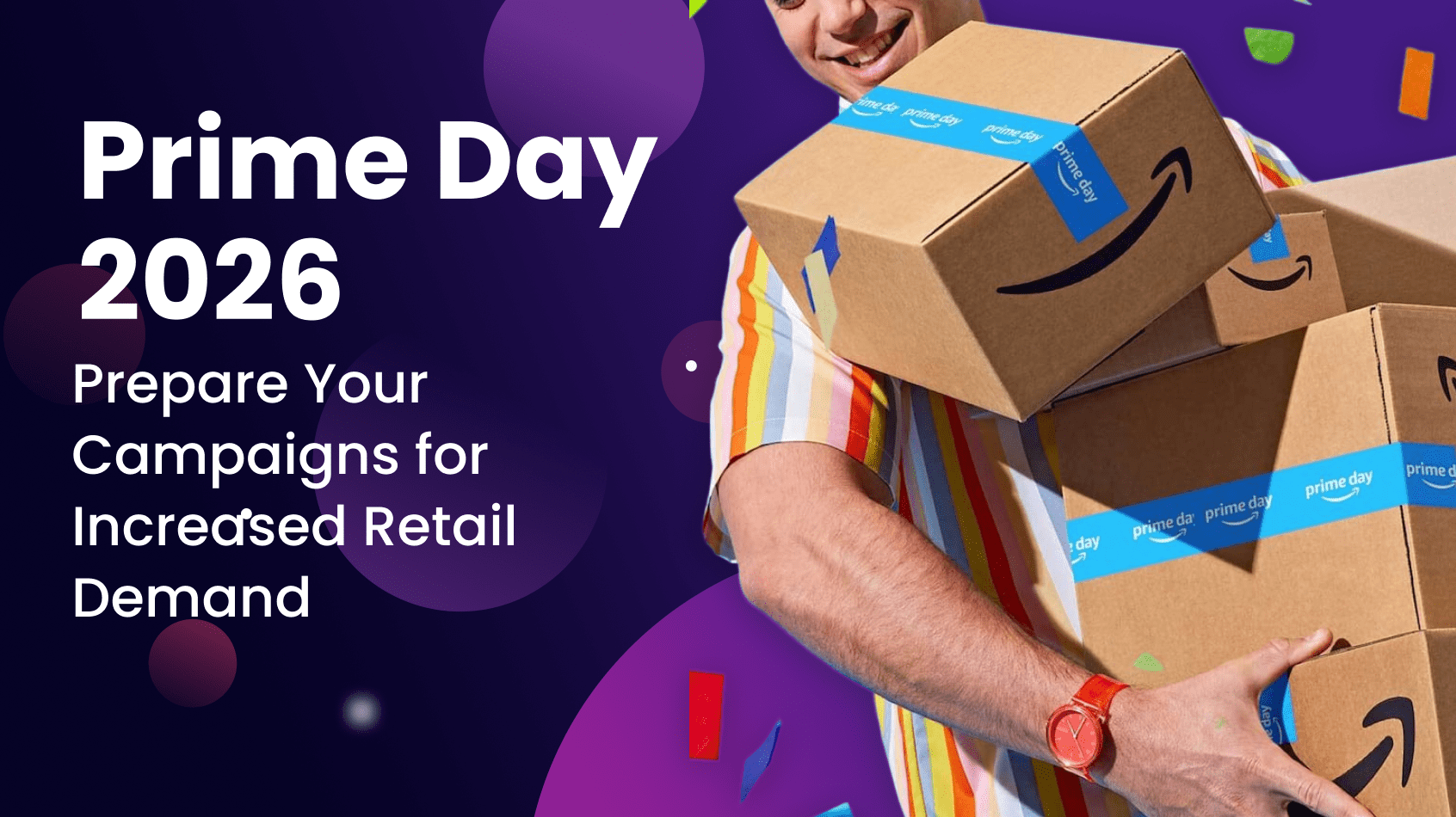
Amazon Prime Day returns this June, bringing with it a surge in purchase demand as shoppers actively seek out deals across a wide range of categories.
Last year’s event set a high benchmark, with record-breaking sales and billions saved across more than 35 product categories, alongside over 1.6 billion items delivered in the UK with same or next-day shipping .
But the impact of Prime Day extends far beyond Amazon.
The scale and visibility of the event create a market-wide shift in behaviour. Shoppers enter a deal-focused mindset, actively comparing options, searching for discounts, and making faster purchase decisions. This surge in intent disrupts auction dynamics, increases competition, and accelerates the path to purchase across all channels.
For advertisers, this creates a critical window. Whether the goal is to drive incremental revenue or protect existing demand, campaigns need to be prepared for:
- Faster, less predictable buying journeys
- Higher traffic volumes
- Increased competition
How Shoppers Behave During Prime Day
Prime Day is no longer a short burst of activity – it’s a sustained period of heightened intent.
The move to a four-day event has driven a 35% year-on-year increase in sales compared to the previous two-day format . Instead of a single spike, demand now builds and sustains across multiple days.
A consistent pattern has emerged:
- Days 1 and 3 are dominated by browsing and basket building
- Days 2 and 4 drive the majority of purchases
- Shoppers move between research and purchase multiple times
At the same time, overall demand intensifies significantly. During the event, average daily order volumes are 136% higher than the typical daily average .
What makes this moment particularly valuable is the combination of intent types:
- Shoppers waiting to purchase higher-ticket items at a discount
- Impulse buyers responding to urgency and limited-time offers
This behaviour is especially visible in categories like:
- Electronics & accessories
- Health & beauty
- Home & kitchen
The result is a highly active, highly motivated audience – one that isn’t confined to Amazon, but actively exploring alternatives across the wider market.around convenience and flexibility.

Building a Strategy for Prime Day Performance
Prime Day requires a different approach to campaign strategy. Standard optimisation for efficiency often breaks under the pressure of increased competition and accelerated buying behaviour.
Insights from Nielsen IQ’s “Prime Day 2025: What Happened and What to Do Next” analysis reinforce a key point: during this period, both purchase volume and order value increase, driven by urgency, discounting, and shifts in consumer intent.
1. Align with Higher-Value Purchase Behaviour
Prime Day encourages shoppers to rethink how they buy.
Rather than single-item purchases, users are more likely to:
- Combine products into larger baskets
- Delay higher-value purchases until discounts are available
- Respond to perceived value rather than just price
To align with this:
- Position bundles as a core offer
- Highlight savings across multiple items
- Give greater visibility to premium products
2. Focus on Categories with Proven Uplift
Not all categories perform equally during Prime Day.
The strongest uplifts are seen in:
- Electronics & Accessories (+4.4%)
- Appliances (+2.6%)
- Health & Beauty (14.9% category share)
These categories benefit from a mix of:
- Planned purchases (where users are waiting for deals)
- Impulse purchases (driven by urgency and visibility)
Campaign messaging should reflect this split:
- Use urgency and discovery-led messaging for impulse
- Lead with value and pricing for considered purchases

3. Capture Demand at Peak Purchase Times
Prime Day conversions are not evenly distributed throughout the day.
The highest purchase activity consistently occurs during:
- 12am – 7am
- 8pm – 10pm
These windows are where competition—and revenue opportunity—is at its highest.
To stay competitive:
- Ensure budgets last the full day
- Avoid early budget exhaustion
- Apply bid adjustments during peak periods
Being visible during these windows can significantly impact overall performance.
4. Adapt Bidding and Budget Strategy
Increased demand brings increased competition.
During Prime Day:
- CPCs rise
- Auction pressure intensifies
- Standard bid strategies may struggle to maintain visibility
To compensate:
- Increase budgets to support full coverage
- Loosen bid targets where necessary
- Prioritise visibility over strict efficiency
This is a short-term shift, but a necessary one to remain competitive.
Protect Your Brand Space
Prime Day creates significant pressure on branded search. As competition increases, more advertisers begin targeting branded terms especially those linked to deals, discounts, and offers.
Expect Disruption in Brand Auctions
Bid strategies such as Target Impression Share may struggle within usual limits as competition intensifies. Maintaining visibility often requires:
- Higher max bids
- Increased budgets
- Greater flexibility in strategy
Maximise Visibility in Search Results
During high-intent periods, occupying as much space as possible in search results becomes critical.
Using ad extensions and richer formats such as multimedia ads allows brands to:
- Increase click share
- Improve engagement
- Reduce the risk of losing traffic to resellers or competitors
Expand Branded Keyword Coverage
Search behaviour shifts during Prime Day, with more queries focused on:
- Deals
- Discounts
- Promotions
To maintain visibility:
- Capture demand across all relevant variations
- Broaden branded keyword coverage
- Use search term insights to identify new opportunities.
Google Ads search term reviews don’t need to be risky. Learn how to spot patterns, make confident exclusions, and avoid over-optimising – read the full article here
Prime Prep Checklist
Preparing for Prime Day requires a coordinated approach across targeting, bidding, creative, and budget strategy.
Key actions include:
- Build dynamic remarketing campaigns to capture early demand
- Increase campaign budgets to maintain full-day coverage
- Apply bid adjustments for peak purchase windows (12am–8am and 8pm–10pm)
- Layer in-market audiences with positive bid adjustments
- Add RSA assets, multimedia ads, and extensions aligned with promotions
- Launch Performance Max campaigns to capture incremental volume
- Create dedicated Shopping campaigns for discounted products
- Apply seasonality adjustments to reflect conversion rate uplifts
- Loosen bid targets to maintain visibility during increased competition
- Expand keyword coverage for deal- and discount-driven searches
Final Thought
Prime Day represents a short but powerful shift in how consumers behave. It’s a moment where, demand increases, competition intensifies and decisions happen faster
The brands that perform best are those that prepare for that shift in advance – adjusting strategy, budgets, and messaging to match how consumers actually behave during the event.
Because during Prime Day, visibility isn’t just important. It’s everything.
Make the most of Prime Day and manage all of your campaigns across your different ad platforms in one place with Adzooma – Sign up free today!