

More tests won’t fix Q4 performance if you’re testing the wrong thing. Read on to learn how to find where your customer journey is really breaking down, from the offer and audience to the landing page, and run tests that give you clear answers instead of more noise.
Q4 creates pressure to act quickly. When conversions slow or costs rise, launching new creative can seem like the obvious solution-but the ad may not be the real problem. If the offer is unconvincing, the audience is wrong or the landing page breaks the promise made before the click, another headline or image will tell you very little. Before starting your next peak-season test, identify which part of the customer journey actually needs attention.
Creative is not always the problem
Creative is visible, which makes it easy to blame. If an ad has a low click-through rate, the message or execution may genuinely be the problem. But when an ad attracts clicks and those visitors do not convert, the issue may sit elsewhere.
Look at the complete journey:
- What are you telling the customer?
- Who are you showing it to?
- How is the message presented?
- What do they see before and after the ad?
- Does the landing page continue the same conversation?
A promotion may sound attractive in the ad but become difficult to understand on the website. A strong product demonstration may be shown to an audience with no interest in the problem it solves. An effective awareness ad may be expected to generate an immediate purchase from someone encountering the brand for the first time.
In each case, replacing the creative treats the symptom rather than the cause.
Identify which layer you are testing
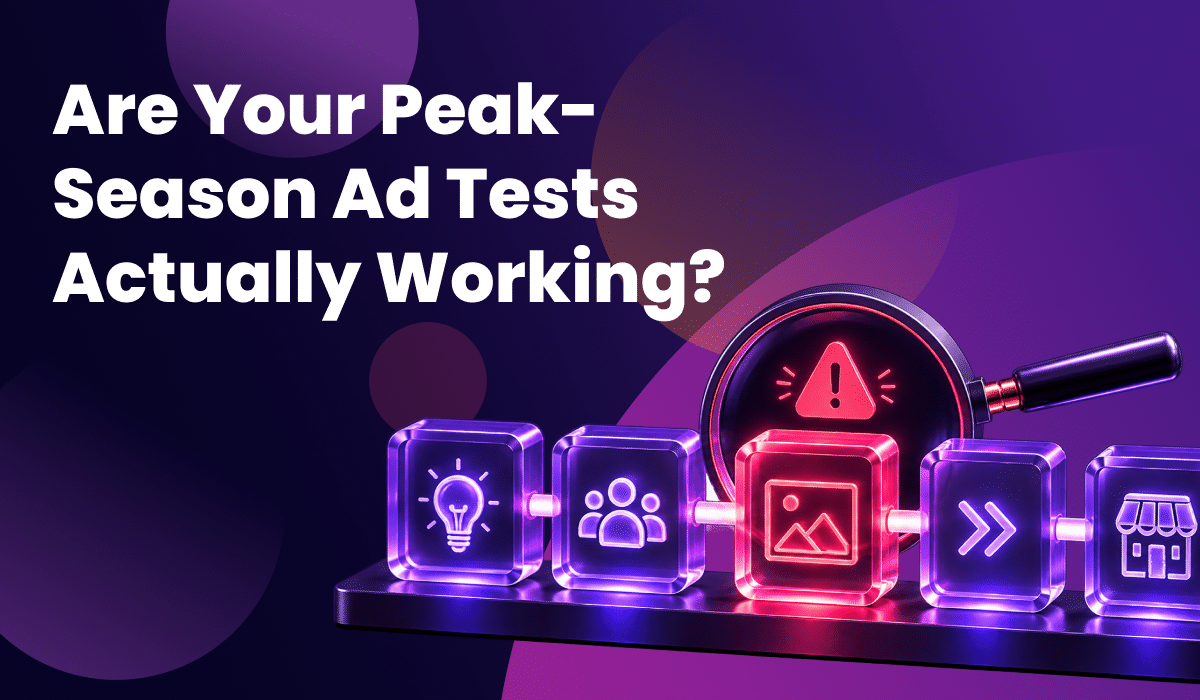
A useful testing framework separates the customer journey into five layers.
1. The angle
What is the central message? During peak season, this might be a discount, convenience, product quality, delivery speed, exclusivity or the problem the product solves.
Testing the angle helps you understand what customers find most compelling. It is more meaningful than changing a few words while keeping the same basic proposition.
2. The audience
Who is the message for? The same product can appeal to different people for different reasons. One audience may care about price, while another values quality or convenience.
Keep the creative consistent while comparing clearly defined audiences. If you change the audience and the ad simultaneously, you will not know which change affected performance.
3. The creative execution
How is the message brought to life? Once you have a credible angle and audience, test the format used to communicate it. This could include:
- Product demonstrations
- Customer reviews
- Creator-led videos
- Static product imagery
- Before-and-after comparisons
- Educational content
- Different headlines and opening hooks
Different assets may also perform different jobs. An educational video may introduce the product effectively, while reviews and product-focused ads help convert people already considering it.
4. The sequence
What does the customer see next? Not every prospect should receive the same message at every stage.
Someone encountering your brand for the first time may need to understand the problem and solution. A previous website visitor may respond better to product benefits, reviews or a time-sensitive offer.
Testing the sequence helps determine whether customers receive the right message at the right moment.
5. The landing page
Does the experience after the click fulfil the promise made in the ad? If the ad promotes a Black Friday offer but the landing page does not immediately explain the discount, customers must search for the information they expected to find.
If the ad educates customers about a complex product but sends them directly to a page designed for people ready to buy, the journey may move too quickly.
The landing page is part of the campaign, not simply its destination.

Automated campaigns can deliver impressive results by prioritising the easiest conversions. Read our article and learn how to check whether your campaigns are creating new growth or taking credit for existing demand.
Test from the top down
Testing the colour of a button will not solve an unconvincing proposition. Producing a polished video will not fix an audience with no interest in the product.
Start with the highest layer that may be broken.
First, establish whether the message is compelling. Then check whether it is reaching the right people. Once those foundations are credible, assess the creative execution, campaign sequence and landing page.
This does not mean every campaign requires a lengthy test at every stage. It means you should diagnose the likely problem before deciding what to change.
Ask:
- Is the offer strong enough for the time of year?
- Does the message explain why someone should choose us?
- Are we reaching people likely to care about it?
- Does the creative communicate the message clearly?
- Does the landing page continue the same journey?
Do not test beneath a layer that is already failing. If the audience is wrong, comparing two versions of the same ad will only reveal which performs less poorly.
Keep the ad and landing page in the same conversation
Consistency becomes particularly important during Q4, when customers compare multiple products, prices and promotions.
The message should continue naturally after the click. Check that your ad and landing page agree on:
- The product being promoted
- The offer or discount
- Promotional dates
- Delivery information
- Stock availability
- The main product benefit
- The action the customer should take
If the ad says “20% off everything” but the landing page includes several exclusions, those conditions should be easy to find. If the creative focuses on next-day delivery, the website should immediately confirm availability and cut-off times.
A disconnect between the ad and landing page can make good creative look ineffective. People may click because the message appeals to them, then leave because the next step does not match what they expected.
Before replacing an underperforming ad, test the entire journey yourself on desktop and mobile.

Put your automation guardrails in place now
Every test should begin with a clear question.
For example:
- Does a convenience-led message outperform a discount-led message?
- Are previous website visitors more responsive to reviews or product demonstrations?
- Does an educational landing page convert better than sending traffic directly to the product page?
- Does showing the product benefit before the discount improve conversion quality?
Write down:
- The hypothesis
- The element being changed
- The metric that will determine success
- How long the test needs to run
- What you will do after each possible result
Without a clear decision at the end, the test becomes activity rather than learning.
Avoid changing several elements simultaneously. If you introduce a new audience, creative, bidding strategy and landing page at the same time, even a strong result will not tell you which decision should be repeated.
Do not let peak-season pressure end tests too quickly
Q4 budgets make advertisers understandably cautious. When a test spends money without generating an immediate return, there can be pressure to stop it.
However, ending too quickly can leave you with an unreliable result.
There is no universal amount of time or spend that makes every test valid. The right threshold depends on your traffic, conversion volume, sales cycle and the size of the performance difference.
Before launching, decide how much evidence you need. Avoid changing the rules because the early results feel uncomfortable.
Not every test should continue indefinitely. If there is a clear technical problem, inaccurate offer or severe decline, intervene. But if the campaign is functioning as intended, give it enough opportunity to provide a useful answer.
Use Q4 to improve more than one campaign
The value of a test should continue after the campaign ends.
Record:
- What was tested
- Why it was tested
- Which audience saw it
- The result
- The decision made
- Where the learning should be applied next
A message that works during early Black Friday activity may inform your final promotional push. A successful landing-page structure could be adapted for Christmas or January campaigns. An audience that responds to educational creative may deserve a different sequence from people motivated by discounts.
Do not judge your testing programme by how many experiments you launch. Judge it by how many produce a decision you can use again.
When peak-season performance changes, resist the urge to automatically blame the ad. Identify whether the problem sits with the message, audience, execution, sequence or landing page, then test the layer most likely to improve the journey.
Better testing is not about producing endless creative variations. It is about learning what to change next.
Want to investigate what may be affecting your Google Ads performance? Try OmniAI Ad Connectors to analyse your campaigns, explore performance changes and identify the areas worth reviewing first.