

Google has recently announced a change to how campaign budgets are paced, and while it may sound like a small technical update, it has real implications for how spend behaves across the month.
From 1st June, campaigns will pace towards the full monthly budget (30.4x your daily budget), regardless of whether your ads run every day or only on a limited schedule. Previously, spend was effectively distributed across the days your ads were eligible to run. Now, the system is designed to ensure the full monthly budget is spent, even if that means pushing spend harder on active days.
On the surface, this aligns with Google’s broader direction: maximise performance within a defined budget. But in practice, it changes how predictable and controllable that spend actually is.
The shift from controlled pacing to outcome-driven spend
Historically, advertisers could rely on a fairly stable relationship between schedule and spend. If a campaign only ran Monday to Friday, budget pacing would naturally adjust to those five days. Spend was constrained not just by budget, but by when ads were allowed to show.
This created a level of predictability. You could anticipate how budget would be distributed and make decisions based on a relatively consistent daily pattern.
With this change, that link is weakened. Google is now optimising towards the outcome – spending the full monthly budget – rather than evenly distributing spend across active days. That means fewer guardrails around how aggressively spend is pushed when your ads are live.
For always-on campaigns, this may not be noticeable. But for accounts with tighter control – fixed budgets, limited schedules, lead targets, or specific dayparting – this introduces a new dynamic.
Where this becomes a problem
The impact is most visible in campaigns that don’t run continuously.
If you’re running ads only on weekdays, for example, the system is no longer pacing across roughly 20 active days. It’s pacing against a full month, which can lead to more aggressive spend on those weekdays to “catch up” to the monthly target.
In practice, that can result in:
- Spend being pushed harder earlier in the month
- Budgets depleting faster than expected
- Daily costs becoming more volatile
- Monthly totals creeping beyond what was originally anticipated
Nothing in your setup has changed, but the way your budget is being used has.
This is where many advertisers will start to feel a loss of control. Performance may still be acceptable at a high level, but day-to-day management becomes less predictable. It’s harder to understand whether you’re pacing correctly, and harder to intervene before issues compound.

Is this actually a bad thing?
Not necessarily. For some advertisers, this change will be beneficial. Campaigns that previously underdelivered due to tight schedules may now be able to fully utilise budget and drive more volume. Accounts already leaning into automation and flexible targeting may see this as a natural extension of how platforms are evolving.
But for others, particularly those working with fixed budgets, strict lead targets, or operational constraints, the trade-off is more noticeable. Predictability matters in those environments, and more aggressive pacing can make performance harder to manage day-to-day.
In reality, this isn’t about whether the change is good or bad. It’s about what it prioritises. Google is optimising for full budget utilisation and overall performance. Not for even pacing or human predictability.
Why this fits Google’s broader direction
This change isn’t happening in isolation. It’s part of a wider shift towards automation and outcome-based optimisation across Google Ads.
Over time, more decisions have moved from the advertiser to the platform: bidding strategies, targeting expansion, creative combinations, and now, more flexible budget pacing. The role of the advertiser is shifting from direct control to setting inputs and constraints.
In that model, the system is designed to use budget as efficiently as possible over a defined period, rather than adhere strictly to human-defined pacing rules.
The trade-off is clear. You gain efficiency and scale, but lose some of the predictability and control that used to make performance easier to manage in real time.

Why visibility matters more than ever
As pacing becomes less predictable, the risk isn’t necessarily overspend in isolation. It’s the lack of visibility into how that spend is unfolding across the month.
If budgets are pushed aggressively early on, it can lead to reactive decisions later – pulling back spend, tightening targets, or missing lead volumes because budget has already been consumed.
Without a clear view of pacing, these issues often only become obvious at the end of the month, when there’s little you can do to correct them.
This is where the focus shifts from control to visibility.
You may not be able to fully dictate how Google distributes spend, but you can understand it earlier, spot when it’s moving off track, and act before it impacts performance.
How Adzooma helps you stay in control
This is exactly the kind of scenario where relying on platform reporting alone becomes limiting. Most native views are retrospective. They show what’s already happened, rather than what’s likely to happen if current trends continue.
Adzooma is designed to close that gap with two key features:
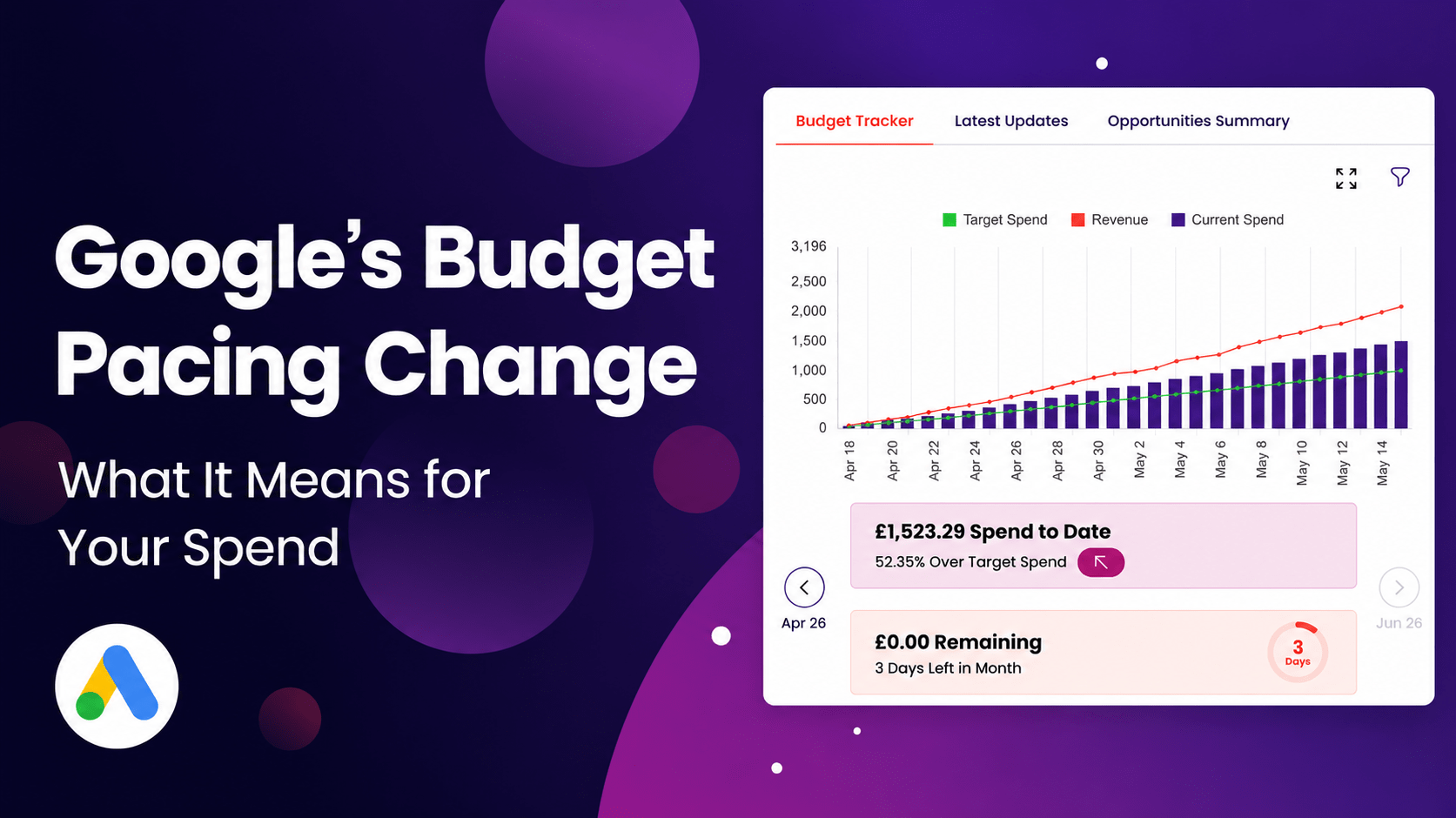
- Budget Tracker gives you a clear, forward-looking view of how your spend is pacing across the month. Instead of waiting for end-of-month totals, you can see whether you’re on track, overspending, or likely to run out early, and which campaigns are driving that movement. This makes it much easier to catch when spend is being pushed too hard early on, and adjust before it creates knock-on effects.
- Alerts act as an early warning system across your account. You can define conditions 2. around spend, CPC, conversions, or performance changes, and get notified the moment something moves outside of what you’d expect. Rather than spotting issues after the fact, you’re reacting in real time while there’s still time to correct them.
Together, these tools shift you from reactive management to proactive oversight. You’re not fighting the platform’s pacing decisions, but you are staying informed enough to guide performance as it unfolds.
Google Ads search term reviews don’t need to be risky. Learn how to spot patterns, make confident exclusions, and avoid over-optimising – read the full article here
What advertisers should do next
This change doesn’t necessarily require a full restructuring of campaigns, but it does require a shift in how you monitor and manage them.
If you’re running campaigns with limited schedules, fixed budgets, or strict performance targets, it’s worth reviewing how your spend behaves over the next few weeks. Pay attention to early-month pacing, daily volatility, and how quickly budgets are being consumed.
More importantly, make sure you have a way to track and respond to those changes as they happen, not just when reports are finalised. Tools like Adzooma’s Budget Tracker and Alerts are free to use, and give you a much clearer view of what’s happening day-to-day so you can stay in control as this change rolls out.
Final thought
Google’s update is another step towards a more automated, outcome-driven model of advertising. That direction isn’t changing.
The difference now is that control isn’t just about how you set up campaigns. It’s about how well you can see what’s happening, and how quickly you can respond.
Because when pacing becomes less predictable, visibility becomes the lever that matters most.
Want to see how Adzooma can help you stay in control of your Google Ads budget pacing? Sign up free today!