

Search terms are one of the most revealing – and misunderstood – parts of a Google Ads account. Think of them as a window into your audience’s mind: they show you exactly what someone typed into Google before your ad appeared. That’s genuinely powerful information. But it’s also the kind of data that can send you spiraling into over-analysis if you’re not careful.
Most advertisers fall into one of two traps. Some avoid search term reviews entirely, too nervous about accidentally cutting something valuable. Others go the opposite direction, pruning anything that doesn’t look like a perfect match. Both habits quietly drain budget and performance over time.
The good news? Getting this right isn’t about being aggressive or cautious – it’s about being systematic.
Why Search Term Reviews Feel Risky
Search terms sit at the intersection of intent and uncertainty — and that combination makes every decision feel loaded. You’re not just looking at data; you’re trying to predict human behaviour from a handful of words.
The anxiety usually surfaces as a loop of “what ifs.” What if that odd-looking term was actually close to converting? What if it just needs a bit more time to find its feet? What if removing it causes a dip you can’t explain to your client or your boss?
These aren’t irrational fears — they’re a natural response to working with incomplete information. The problem is that they tend to push advertisers toward one of two extremes: either avoiding the review altogether, or scrubbing the account so hard that you cut off terms that were quietly doing useful work.
The Mistake: Treating Search Terms Like a Cleanup Task
It’s tempting to approach a search term report like a cluttered inbox — scroll through, remove anything that looks out of place, and feel good about having tidied things up. The problem is that search terms aren’t really a housekeeping task. They’re a source of signal, and signal needs to be read before it gets removed.
When advertisers get into cleanup mode, they tend to move fast. A term looks irrelevant, so it gets excluded. Another looks weird, so that goes too. But “looks irrelevant” and “is irrelevant” aren’t the same thing — and the gap between them is where budget decisions quietly go wrong. Cutting too aggressively can shrink your volume unnecessarily, interrupt the algorithm’s learning, and eliminate terms that might have converted further down the funnel.
The search term report isn’t meant to look perfect. It’s meant to help you make better decisions — and that requires slowing down long enough to understand what you’re actually looking at.
What to Look for First
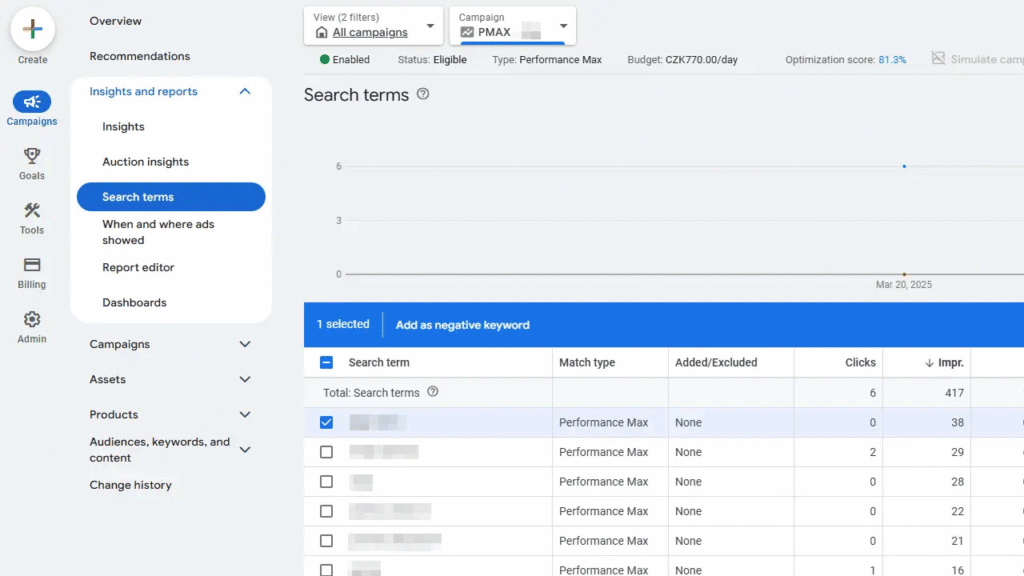
A calmer way to approach the report is to shift your focus from individual words to intent. A single strange-looking term rarely tells you much on its own — what you’re really hunting for are patterns that repeat across multiple searches.
When you’re scanning through, prioritise these three signals:
- Clear mismatches. Terms that have nothing to do with what you offer — wrong industry, wrong audience, wrong context. These are the easy wins.
- Spend without contribution. Searches that have quietly accumulated budget over time without driving any meaningful results. Not one click — consistent, repeated spend with nothing to show for it.
- Misaligned themes. Clusters of searches that make sense in isolation but don’t fit what your campaign is actually trying to achieve.
One outlier term on a bad day isn’t a problem worth acting on. A theme that keeps showing up across different searches? That’s worth your attention.
When It’s Better to Leave a Term Alone
Knowing when not to act is just as valuable a skill as knowing when to exclude. Premature exclusions are quieter than over-spending, but they can be just as damaging — and they’re a lot harder to spot after the fact.
It’s usually worth holding off when:
- The term is new. Fresh terms need time and volume before they tell you anything useful. Excluding based on a handful of impressions isn’t analysis — it’s impatience.
- The data is too thin to read. Low volume means high variance. A term with three clicks and no conversions isn’t underperforming; it just hasn’t had a fair chance yet.
- Performance is inconsistent, but not clearly declining. Fluctuation is normal, especially in smaller accounts. If there’s no clear negative trend — just some weeks better than others — that’s not a signal to act on.
Not every term that hasn’t converted is a problem waiting to be solved. Some are simply part of how the algorithm explores and learns. Cutting them too soon doesn’t just remove a term — it removes the information that term was in the process of generating.

How Often Should You Review Search Terms?
Search term reviews don’t need to be a daily ritual — and treating them like one can actually work against you. Checking too frequently means you’re constantly making decisions on thin data, which tends to produce reactive exclusions rather than considered ones.
For most accounts, a steadier rhythm tends to produce better outcomes:
- Spaced reviews beat frequent ones. Giving terms time to accumulate meaningful data before you evaluate them leads to better decisions. How long depends on your account’s volume, but the principle holds across the board — more data, clearer signal.
- Context beats snapshots. Reviewing a term over a reasonable time window tells you something. Reviewing it after a short blip tells you almost nothing. The wider your view, the less likely you are to act on noise.
- Confident, selective exclusions outperform aggressive pruning. A smaller number of well-reasoned exclusions will do more for your account than a long list of reactive ones. Quality of decision matters more than quantity.
The accounts that handle search terms well aren’t necessarily the ones reviewing most often. They’re the ones reviewing with enough data to actually know what they’re looking at.
How Tools Help Bring Perspective
As accounts scale, search term reports don’t just get longer — they get harder to read. What starts as a manageable list can quickly become hundreds of rows of data, and at that point, the human eye starts to miss things. Patterns blur. Outliers hide. And the temptation to either rush through or avoid the review altogether gets stronger.
That’s where tools like Adzooma start to earn their place:
- Surfacing themes instead of isolated terms. Rather than forcing you to spot patterns manually, good tooling groups and highlights recurring themes — so you’re responding to meaningful signals, not getting lost in individual rows.
- Making problem spend easier to see. Terms that have quietly accumulated budget without delivering results can be easy to overlook in a long report. Tools bring them to the surface so they don’t stay hidden.
- Supporting trend-based decisions over instinct. Instead of reacting to how a term looks on a given day, you get a clearer view of how it’s actually been performing over time — which leads to more confident, better-reasoned exclusions.
The goal was never to exclude more. It’s to exclude with enough clarity that every decision you make is one you can stand behind.
How are you managing your Google Ads budgets? Read our article to find out if you’re making this common mistake.
Final Thought
Search term reviews get a lot easier once you stop approaching them like a to-do list that needs clearing. The data in that report isn’t mess to be tidied — it’s information about how real people are finding you, and it deserves a bit more curiosity than a quick scroll and a batch of exclusions.
When the mindset shifts from cleanup to analysis, something changes in how the decisions feel too. You’re no longer trying to make the report look right. You’re trying to understand what it’s telling you — and then acting on that, deliberately and without panic.
That’s when search term management stops feeling like a risk and starts feeling like an advantage. And sometimes, the most effective thing you can do after a thorough review is close the report and leave everything exactly as it is.
Want to simplify and optimise your Google Ads campaigns? Adzooma makes helpful recommendations and helps you to manage all of your campaigns and ad tools in one platform. Sign up free today!