

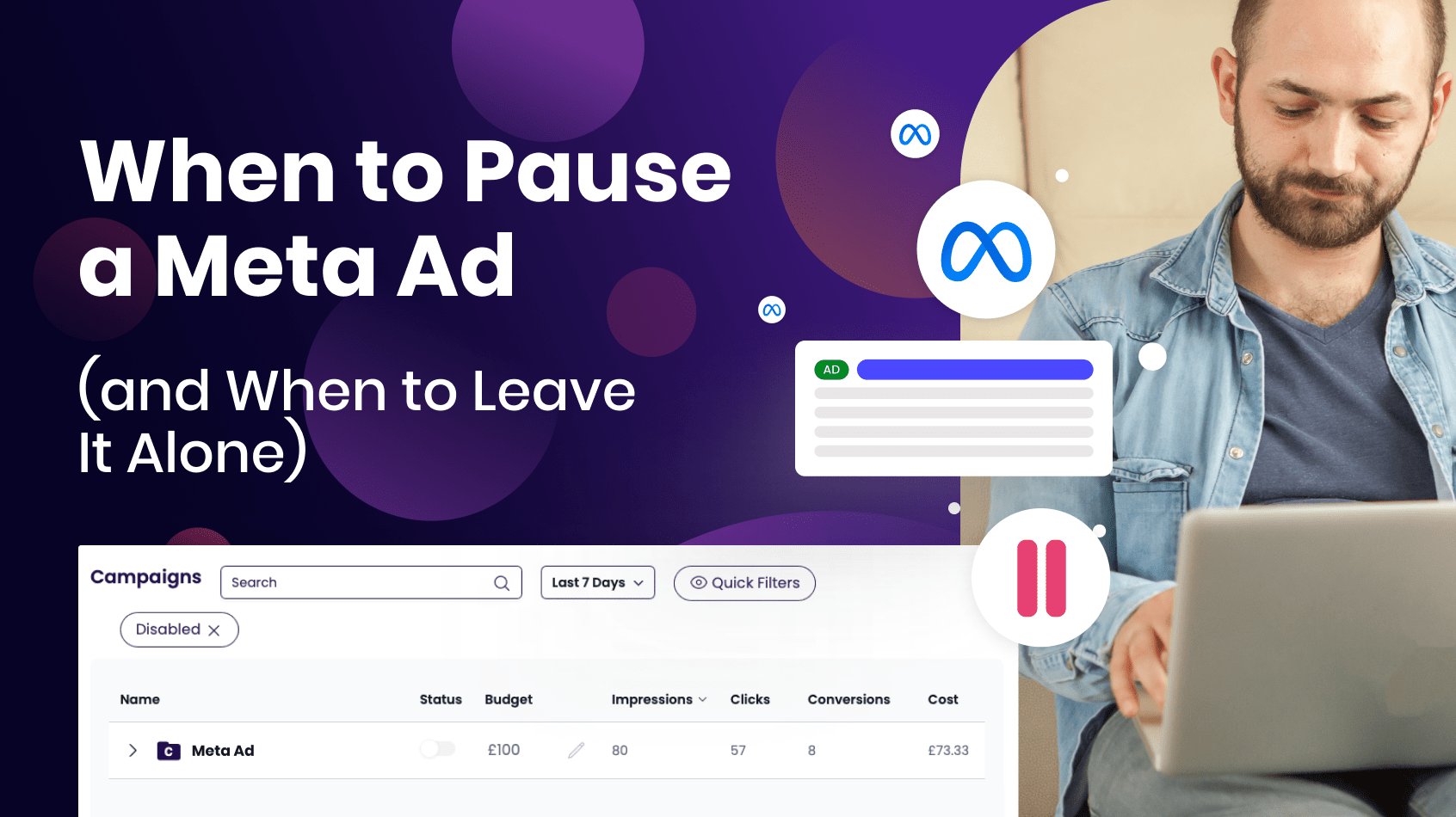
Meta Ads rarely fail overnight. Learn how to spot performance plateaus early and make small adjustments before results decline.
Meta campaigns rarely deteriorate dramatically overnight. In most accounts, performance weakens gradually before it becomes obvious. Cost per acquisition begins to climb incrementally. Click-through rates soften. Conversion volume fluctuates. Nothing looks catastrophic, yet overall efficiency quietly erodes.
This is the stage where many advertisers make their most expensive decisions.
Pausing ads often feels decisive. It signals control. It suggests active optimisation. However, in Meta’s machine-learning environment, premature interruption can destabilise delivery, reset optimisation signals, and increase volatility rather than solve the underlying issue.
Understanding when performance is genuinely declining — and when it is simply normal fluctuation — is one of the most valuable optimisation skills a performance team can develop.
What a Meta Performance Plateau Actually Looks Like
A plateau is not a bad day. Nor is it a three-day dip following a budget change.
In most cases, a plateau develops through:
- A gradual increase in CPA over 7–14 days
- A slow decline in click-through rate or engagement rate
- Reduced conversion rate despite stable traffic quality
- Higher frequency paired with lower engagement
- Increasing CPMs without proportional performance gains
The important distinction is trend versus moment. Meta’s delivery system naturally fluctuates due to auction competition, audience saturation, creative exposure cycles, and broader market factors. Reacting to short-term volatility can interrupt otherwise healthy campaigns.
A plateau becomes meaningful when multiple metrics shift direction together and remain there long enough to suggest structural change rather than auction noise.
Why Advertisers Pause Too Early
In practice, ads are rarely paused because they have fully exhausted their potential. They are paused because performance uncertainty creates discomfort.
Common triggers include:
- A sudden rise in CPA without context
- Pressure to “do something” during short-term dips
- Concern over perceived budget waste
- Creative fatigue that feels obvious but isn’t yet statistically validated
Without predefined decision rules, optimisation becomes reactive. And reactive optimisation often creates more instability than the original issue.
In Meta’s ecosystem, consistency supports learning. Repeatedly pausing, editing, and relaunching ads forces the algorithm to re-evaluate delivery patterns, audience responsiveness, and bid efficiency. Over time, accounts with high intervention frequency tend to experience greater volatility and less predictable scaling.

The Hidden Cost of Frequent Pausing
Every pause disrupts momentum.
When an ad is stopped:
- Delivery patterns reset
- Budget allocation rebalances
- Learning signals are interrupted
- Auction position shifts
If the ad was in or near the learning phase, that interruption can delay stabilisation further. Even outside learning, stop–start behaviour can reduce the system’s ability to refine delivery efficiently.
This does not mean ads should never be paused. It means that pausing should follow evidence, not discomfort.
When Pausing Is Strategically Justified
There are circumstances where pausing is the correct response. The key is duration and consistency.
Pausing typically makes sense when:
- CPA has increased materially (e.g. 20–30%+) over a 7–14 day period with no improvement
- Conversion rate has declined while click quality remains stable
- Frequency continues to rise while engagement drops
- Creative fatigue is measurable, not assumed
- A replacement creative is ready to test
In these cases, continued spend is unlikely to self-correct. Structural change is required.
However, if only one metric has shifted — for example, CPM has increased due to seasonal competition — the appropriate response may involve bid strategy adjustment or audience expansion rather than pausing creative.

When It Is Better to Leave an Ad Running
There are equally important moments when restraint protects performance.
It is often better to leave ads active when:
- Performance dipped immediately following a budget adjustment
- An ad is still within or just beyond the learning phase
- Results fluctuate but recover within short cycles
- Conversion volume is low, making short-term data unreliable
In low-volume accounts especially, small sample sizes can exaggerate apparent decline. A campaign generating 2–3 conversions per day will naturally show volatility that does not reflect long-term inefficiency.
In these cases, the most effective action is structured monitoring rather than interruption.
Diagnosing the Cause Before Acting
Instead of defaulting to pausing, high-performing teams diagnose first.
When performance softens, ask:
- Has audience saturation increased?
Rising frequency paired with declining CTR often signals creative fatigue rather than audience exhaustion. - Has competition intensified?
Seasonal or industry-wide events can inflate CPMs temporarily. - Has conversion behaviour shifted?
External factors such as pricing, website changes, or broader economic conditions can impact results independent of ad quality. - Has campaign structure changed recently?
Budget adjustments, bid strategy shifts, or audience exclusions can temporarily disrupt delivery.
By isolating the likely driver, optimisation becomes targeted rather than reactive.
Are you obsessing over the wrong Meta Ads metrics? Read our article to find out which ones you should and shouldn’t be tracking.
A More Sustainable Optimisation Rhythm
Strong Meta accounts are not characterised by constant changes. They are defined by structured review cycles.
High-performing teams typically:
- Review trend data weekly, not daily
- Compare ads within the same campaign context
- Evaluate performance across a meaningful date range
- Introduce new creative before retiring existing winners
- Limit simultaneous changes
This rhythm reduces noise and allows patterns to emerge clearly.
Tools such as Adzooma support this process by surfacing sustained underperformance rather than short-term fluctuation, helping teams anchor decisions in trend data rather than instinct.
Responding Early — Without Overreacting
The most effective optimisation sits between neglect and overcontrol.
If early plateau signals appear, consider:
- Refreshing creative while keeping the ad set stable
- Testing new hooks or formats before pausing top performers
- Adjusting audience size or exclusions
- Rebalancing budget across stronger ad sets
These actions preserve learning while introducing variation. They address drift without destabilising delivery.
The Real Skill: Timing, Not Activity
Meta rewards consistency and clarity. Excessive intervention increases uncertainty in delivery and measurement.
Pausing ads is not inherently good or bad. It is a tool.
The real advantage comes from knowing whether performance decline is structural, cyclical, or statistical noise — and responding proportionately.
Campaigns rarely fail because advertisers waited one extra day. They often struggle because optimisation decisions were made without sufficient evidence.
Understanding the difference between a plateau and a fluctuation is what separates stable growth from reactive management.
And in Meta advertising, stability is often the most underestimated performance lever of all.
Want to simplify and optimise your Meta Ads campaigns? Adzooma makes helpful recommendations and helps you to manage all of your campaigns and ad tools in one platform. Sign up free today!