

Over the past few years in PPC, paid media platforms have moved in a clear and consistent direction. Campaign types such as Google Performance Max and Meta Advantage+ have reduced the level of manual control available to advertisers, placing greater emphasis on aggregated data, broader targeting, and machine learning-led optimisation. Guidance from Google, Meta and Microsoft Advertising has followed the same trajectory, consistently encouraging consolidation over fragmentation and signal quality over manual intervention.
None of this is particularly controversial. Most practitioners would recognise these shifts and broadly agree with them. The more interesting question is why so many accounts still fail to reflect what the industry now largely accepts as best practice.
What the industry broadly agrees on
If you step back from platform-specific language, there is a noticeable level of alignment across PPC on what drives performance today.
At a high level, most experienced practitioners would agree that:
- Campaign consolidation tends to outperform heavily segmented structures, as it allows algorithms to learn from a larger pool of data
- Broad targeting has become more effective than restrictive audience definitions in many scenarios, particularly within automated campaign types
- Creative is now one of the primary drivers of performance, especially across paid social
- Data quality (particularly conversion tracking) underpins everything else
These aren’t emerging ideas. They are reflected in how platforms are built, how features are evolving, and how successful case studies are framed. The shift away from manual control towards signal-based optimisation has been gradual, but it is now well established.
And yet, most accounts don’t reflect this
Despite that alignment, the reality across many advertiser accounts looks very different.
It’s still common to see:
- Campaigns split unnecessarily, limiting data and slowing optimisation
- Overly tight targeting that restricts scale rather than improving efficiency
- Minimal creative variation, particularly in accounts that rely heavily on paid social
- Conversion tracking that is technically “in place” but not robust enough to support reliable optimisation
On the surface, these accounts often appear healthy. Spend is active, conversions are being recorded, and key metrics are within expected ranges. But underneath, performance is frequently capped by structural and strategic limitations that are well understood – yet not addressed.

Why the gap exists
The reasons for this gap are less about capability and more about behaviour.
In practice, several patterns tend to show up repeatedly.
1. A preference for control over learning
Many advertisers are still more comfortable with tightly controlled setups, even when those setups restrict performance. Narrow targeting, granular campaign structures, and manual adjustments offer a sense of precision, but they often come at the cost of scale and efficiency.
2. Internal constraints that shape strategy
PPC decisions rarely happen in isolation. Creative output may be limited by brand guidelines or approval processes. Testing may be slowed by internal workflows. In some cases, the “ideal” strategy is simply not feasible within the organisation’s operating model.
3. Legacy thinking that hasn’t caught up with platforms
Approaches that were effective a few years ago – particularly around segmentation and targeting – are still widely used. The platforms, however, have evolved. Strategies that were once best practice can now actively limit performance if they are applied without adjustment.
4. An over-reliance on surface-level metrics
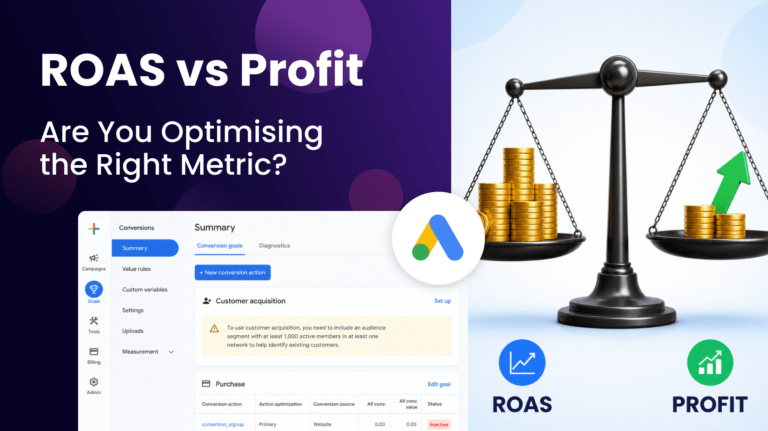
Metrics such as ROAS, CPA, and CTR still dominate reporting, but they don’t always tell the full story. Optimising too aggressively towards efficiency can reduce reach, limit exploration, and ultimately cap growth. In some cases, campaigns are “optimised” into stability rather than scale.
What this means in practice
The result is a consistent pattern across accounts: campaigns that are technically functional, but strategically constrained.
You might see a Performance Max campaign that is live, but built on poor product segmentation. A Meta account that is spending consistently, but relying on a very limited set of creatives. A well-structured search account that is constrained by overly cautious budget allocation. In each case, the issue isn’t that the advertiser doesn’t understand what to do – it’s that the implementation hasn’t followed through.
This is where the gap becomes commercially significant. Small structural decisions, repeated over time, can have a material impact on performance, particularly at scale.
Closing the gap
Closing this gap doesn’t require a new set of tactics. In many cases, it requires applying the ones that are already widely understood.
That typically means:
- Prioritising data quality and ensuring conversion tracking is accurate and actionable
- Simplifying account structures where fragmentation is limiting performance
- Allowing broader targeting where platforms are designed to operate that way
- Increasing investment in creative development and iteration
- Evaluating performance beyond headline efficiency metrics
None of these changes are especially complex in isolation. The challenge is making them consistently, and often in environments where there is pressure to maintain control, minimise risk, or adhere to established processes.
Final thought
The industry is not short of insight. If anything, there is now a clearer consensus than there has been for some time on what drives PPC performance.
The real challenge is execution.
Because the advertisers who outperform over the next 12 months are unlikely to be the ones with access to better tactics. They will be the ones who are willing – and able – to implement what is already known, even when it requires a shift in how they plan, measure, and manage their campaigns.
Want to manage your Google Ads and Microsoft Ads in one place? Adzooma makes it easy to manage and optimise all of your campaigns in one platform. Sign up free today!