

In most ecommerce PPC accounts, performance is measured at the campaign level, budgets are adjusted based on overall return, products are grouped together based on category, and decisions are made using aggregated metrics such as ROAS or CPA. On the surface, this approach is logical. It simplifies management and provides a clear view of performance.
The issue is that it often hides what is actually happening underneath – at the level of the individual products being advertised.
Each product in a feed (often referred to as a SKU, or stock keeping unit) behaves differently in an auction. Some convert quickly, some introduce new customers, and some support other purchases further down the line. When those differences between SKUs are ignored, performance is harder to interpret and even harder to improve.
The problem with campaign-level thinking
Campaign-level reporting encourages a simplified view of performance.
If a campaign is hitting target ROAS, it is considered successful. If it falls below target, it is adjusted or scaled back. While this works as a high-level control mechanism, it overlooks how individual SKUs contribute to that outcome.
Within a single campaign, you will typically find a mix of SKUs that behave very differently:
- Some drive strong, efficient conversions
- Some attract new customers but convert at a lower rate
- Some rarely convert directly but contribute to overall basket value
When all SKUs are evaluated together, the nuance is lost. High-performing SKUs can mask underperformance elsewhere, while SKUs that contribute indirectly to revenue can be deprioritised or removed entirely.

Not all SKUs are meant to do the same job
One of the most common issues in ecommerce PPC is the assumption that every SKU should meet the same performance threshold.
In reality, different SKUs tend to play different roles within an account.
Some act as primary revenue drivers. These SKUs are typically bestsellers or high-demand products that convert efficiently and can justify consistent investment.
For example, a fashion retailer might have a core black dress that consistently delivers a strong ROAS. This product can support aggressive bidding and scale because it reliably converts.
Others function as entry-point SKUs. These products attract new users into the funnel, often through broader or more competitive queries. Their direct return may be lower, but they generate demand that converts later.
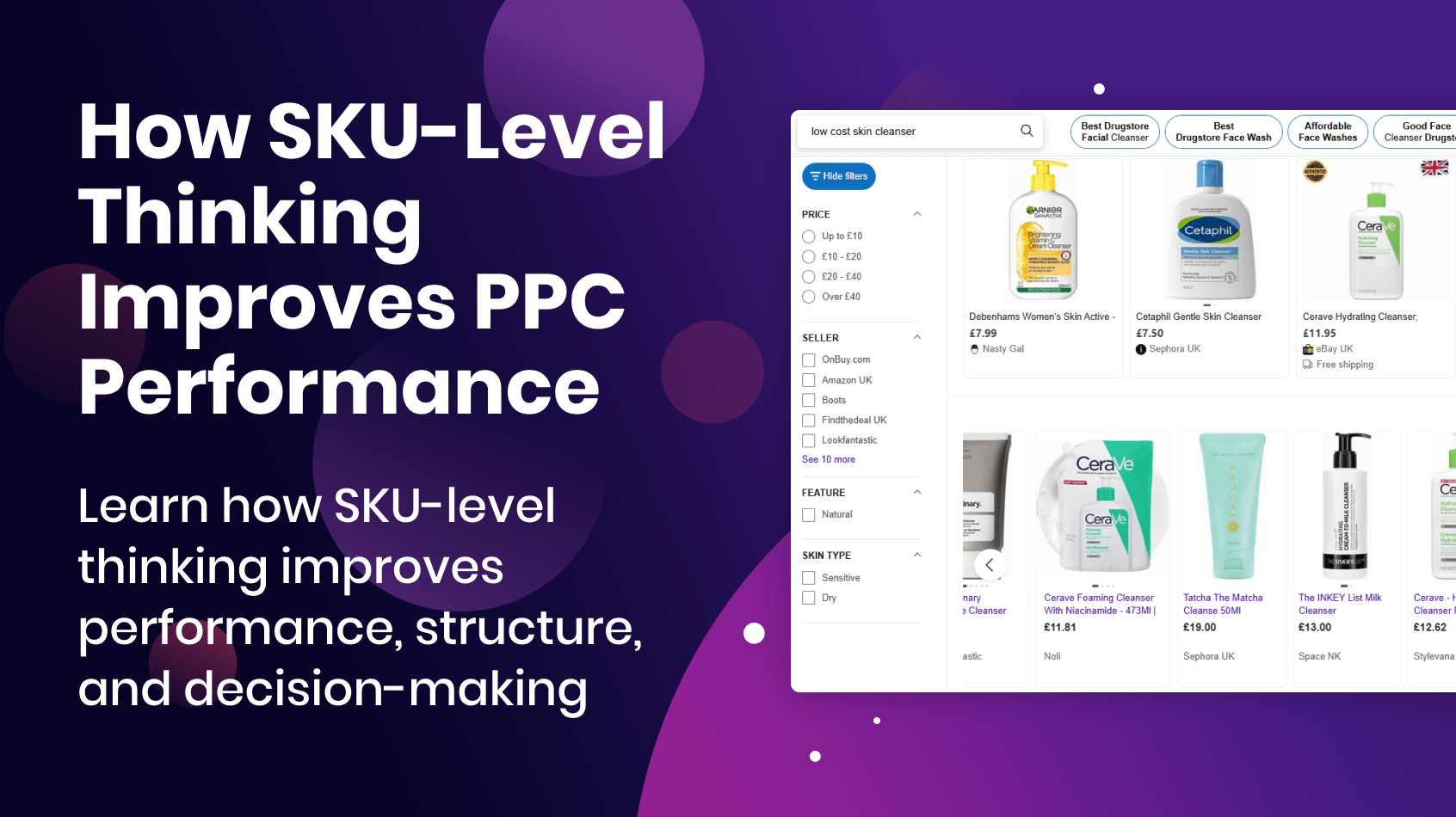
For example, a skincare brand might promote a lower-cost cleanser. It may not deliver strong immediate return, but it introduces new customers who later purchase higher-margin products.
There are also supporting SKUs. These might be accessories, lower-margin items, or niche products that don’t perform strongly on their own but contribute to overall order value or brand presence.
For example, a furniture retailer might advertise cushions or add-ons that rarely convert in isolation, but frequently appear in larger basket purchases.
When all SKUs are judged against a single efficiency target, decisions become skewed. SKUs that don’t immediately meet ROAS targets are reduced, even if they play an important role in the wider performance of the account.
How this shows up in Performance Max
This becomes more pronounced in campaign types such as Google Performance Max, where multiple SKUs are grouped together and optimisation happens at an aggregate level.
Performance Max is designed to maximise conversion value across a product feed, not to differentiate between the strategic roles of individual SKUs. Without intentional structure, the system tends to favour what is already working.
In practice, that can mean:
- Budget is concentrated on a small group of high-performing SKUs
- New or exploratory SKUs struggle to gain traction
- SKUs with different roles compete against each other for spend
The result is often stable performance, but limited growth.

Why SKU-level thinking changes how you structure accounts
This is where SKU-level thinking becomes important.
It doesn’t mean managing every individual product manually, but it does mean recognising that not all SKUs should be treated the same – and reflecting that in how campaigns are structured.
That might involve:
- Separating high-performing SKUs from those that need more testing
- Grouping SKUs based on behaviour, not just category
- Allowing different performance targets depending on the role a SKU plays
- Using feed optimisation to influence how specific SKUs are prioritised
This kind of structure gives platforms better signals and gives advertisers more control over how budget is distributed across different types of products.
The limitation of ROAS at SKU level
ROAS remains a useful benchmark, but it becomes more complex when applied at SKU level.
If every SKU is expected to hit the same efficiency target, it can lead to:
- Reduced visibility for SKUs that introduce new customers
- Over-investment in a small set of best-performing SKUs
- Limited testing of new or seasonal products
Over time, this narrows the account and makes it more dependent on a small portion of the product catalogue.
A more effective approach is to evaluate SKUs based on their role, not just their immediate return.
Confused about your PPC performance? Learn why PPC accounts don’t always reflect what is actually working in our article.
What stronger accounts tend to do differently
Accounts that perform well over time tend to take a more deliberate approach to SKU management.
They are more likely to:
- Review performance at SKU level rather than relying solely on campaign averages
- Accept that different SKUs require different expectations
- Build structure around SKU roles rather than default categories
- Use automation, but guide it with better inputs
This allows them to balance efficiency with growth, rather than optimising too heavily in one direction.
Final thought
Ecommerce PPC is often managed at a level that is too high to reflect how performance is actually generated.
Campaigns provide an overview, but performance is driven by the individual SKUs within them – each behaving differently, each contributing in different ways.
Recognising that every SKU has a job – and structuring accounts accordingly – is what allows advertisers to move beyond stable performance and into sustainable growth.
Because ultimately, the question isn’t just whether a campaign is working, it’s whether each SKU inside it is doing what it’s supposed to do.
Working in Ecommerce PPC? Adzooma makes it easy to manage and optimise all of your ecom campaigns in one platform. Sign up free today!