

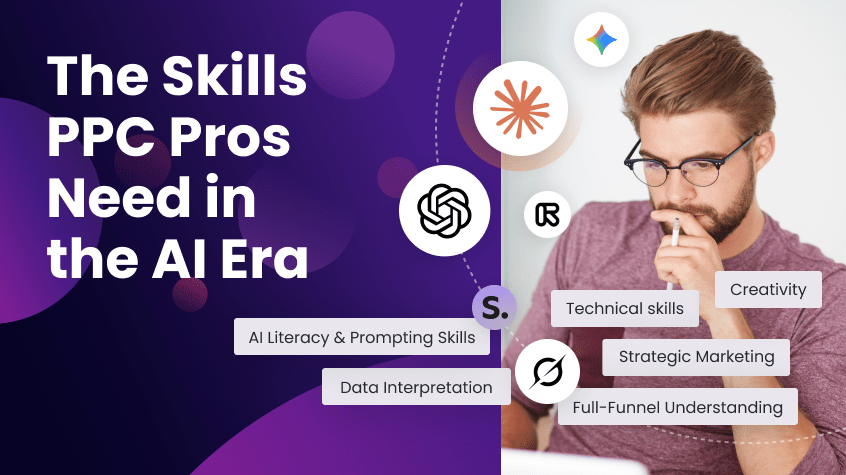
AI isn’t here to take over your PPC job, but it is rewriting the job description. We cover the essential skills you’ll need if you want to stay valuable in 2026 and beyond.
Automation, machine learning, and generative-AI tools are transforming how paid campaigns are built, optimized, and reported. With 2026 almost here, now is the perfect time to reassess your skills and make sure you’re prepared for the year ahead. AI looks set to continue making big changes – not just in the world of PPC, but across business, technology, and daily life. For PPC professionals, that means adapting quickly is no longer optional. Things are changing at a fast pace, and staying ahead means more than just knowing how to set bids or write ad copy.
As automation takes over more of the day-to-day tasks, PPC pros are moving into a new role: part analyst, part strategist, part technologist… and part creative storyteller. If you want to stay valuable in 2026 and beyond, here are the essential skills you’ll need.
AI Literacy & Prompting Skills
It’s tempting to think of AI as a magic black box, but the reality is more mundane (and more powerful): AI delivers exactly what you ask it to do. And that means your skill in asking the right questions, writing good prompts, interpreting AI output carefully, and knowing the limitations matters enormously.
- According to recent surveys, upwards of 75% of PPC professionals report using generative AI at least “sometimes” for tasks like writing ads, doing keyword research, or drafting emails. (Backlinko)
- But using AI doesn’t guarantee success — only about two-thirds of those using AI-generated ads or emails report being satisfied with the outputs. (Backlinko)
That gap highlights the role of human judgement: as a PPC pro, you need to know how to prompt, how to interpret what comes back, and how to refine it. Whether you’re asking an LLM to generate ad copy or feeding conversion data into predictive models, clarity, structure and validation are key.
Think of prompting as the “new Excel formula skill” – essential, but subtle. It might not feel glamorous, but it becomes a superpower if you master it.
Data Interpretation & Analytical Thinking
AI dashboards, predictive models and attribution tools are great, but they don’t replace the need for human interpretation. In fact, as automation grows, the ability to read between the lines becomes even more critical.
- The number of marketers using AI for analytics or reporting remains relatively modest — a 2025 marketing survey found that many marketers are still not using AI for analytics or reporting. (SQ Magazine)
- Meanwhile, campaign data is increasingly complex, combining cross-channel signals, user behaviour, cross-device conversions, retargeting, and more. Tools like SOMONITOR, which combine explainable AI with large language models for marketing analytics are emerging, specifically designed to help marketers make sense of huge datasets while preserving human oversight. (arXiv)
As a PPC pro in the AI era, you’ll need to:
- Spot real trends versus statistical noise (or AI-generated anomalies)
- Assess incrementality, attribution, and cross-channel effects
- Translate data into strategic insights and action plans for business goals
- Ask the right questions. Not just “What happened?”, but “Why did it happen?” and “What should we do next?”
“It’s still so important to know how to test and hypothesise,” says AJ Wilcox, Founder of B2Linked. “If you’re good at testing and looking at the statistics, you are going to learn from your PPC campaign results so much faster and more efficiently than anyone who’s just in an ad channel, expecting to learn how it reacts.
“I’m really grateful I took statistics classes and have that background. I do a lot of testing, and it really makes all the difference.”
In short: not just data-driven, but data-savvy.
Technical Skills (Beyond the Basics)
Even as AI handles more of the heavy lifting like bidding, placements, and certain optimisation, technical literacy remains a differentiator. The most successful PPC pros won’t just submit budgets and ad copy, they’ll understand how the plumbing works.
Here are some technical skills that matter:
- Proper tracking setups: tags, conversion tracking, feed optimization, server-side or API-based tracking — ensuring your data is clean and usable.
- Automation and scripting: being able to use or work with tools that automate repetitive tasks, integrate with CRM or analytics tools, or manage cross-platform campaigns.
- Understanding AI tool integration: not as a trendy badge, but as part of the workflow — how AI tools interface with ad platforms, analytics, data warehouses, and creative assets.
While technical skills don’t require being a developer, a basic comfort with analytics, data flows and digital infrastructure can give a PPC manager major leverage.

Strategic Marketing
AI may be able to handle bids, placements, and optimisation but it can’t replace marketing instinct, brand thinking, or strategic vision. As routine tasks get automated, PPC experts need to double down on strategic thinking.
Specifically, you’ll need to:
- Understand the customer journey — from awareness through conversion and beyond
- Align campaigns with brand positioning, messaging, and broader company goals or KPIs
- Design audience targeting, segmentation, and cross-channel flows with purpose, not just automation
- Understand how different channels (search, display, social, retargeting) fit together, and orchestrate them for maximal effect
AI-enabled PPC is increasingly about activation and journey orchestration rather than just “set & forget.” As one 2025 study noted, many ad-tech and agency respondents said targeting and content generation are the functions most often powered by AI, and that they intend to maintain or grow that investment (PPC Land).
You’ll also need commercial awareness, which is something that Matt Beswick, Paid Marketing Manager at Quality Bearings Online points out is all too often forgotten.
“I think while AI is becoming more and more important, those foundational skills are still just as important as ever, people need to remember that the person still drives the machine,” he warns. “If you’ve not got those foundational skills, you’re still going to struggle whether you use AI or not. And I think the most important one that I see in accounts is a lack of commercial awareness.
“People don’t understand all the things that you need to do to make money, after the ad has been clicked. You can lean on AI for certain things, but it’s not going to replace your own commercial awareness and knowing exactly what that business needs to succeed.”
Creativity
Here’s the irony: the more we lean on automation, the more creative we need to be. As many marketers adopt AI for ad creation, copywriting, and visual assets, it becomes increasingly important to inject originality, feeling and human insight into campaigns.
- In the UK (and beyond), many marketers treat AI as a productivity tool — but continue to rely on human creativity for strategy, tone, storytelling, and brand voice. (TechRadar)
- Even as AI-generated content grows, human edits remain the norm: 97% of UK marketers using AI for creative assets say they still edit AI outputs before publication. (TechRadar)
That makes creativity a rare and valuable differentiator. Whether it’s writing compelling ad copy, devising clever hooks, crafting messages aligned with brand identity, or experimenting with new ideas, PPC pros who bring creativity to the table will get ahead.
AI can suggest a headline or build a rough draft, but only you can give it soul, relevance, nuance.
Cross-Channel & Full-Funnel Understanding
PPC is no longer just about search or single campaigns. As consumers bounce between devices, channels, and touchpoints, PPC pros need to think bigger across the whole funnel.
- Modern marketing increasingly emphasises full-funnel strategies, where upper-funnel visibility, mid-funnel engagement and lower-funnel conversion work together. That means PPC pros can’t just focus on clicks and conversions — they need to understand how search integrates with social, content, SEO, display, retargeting, and more.
- AI tools themselves are becoming cross-channel: automated platforms often optimise across channels, using signals from different touchpoints to steer bids and placements. According to a recent report, 85% of ad-tech and advertising companies surveyed said they plan to maintain or increase investments in AI-powered tools across campaign functions. (PPC Land)
“It’s actually a really exciting time to be in PPC and in marketing in general right now,” says Safyah Akhtar, Head of Paid Media at Hallam. “Because there’s so much to try and test and learn and understand what’s happening. There’s four main search behaviours now. It’s not just searching, they’re scrolling, they’re streaming, they’re shopping. It’s completely diversified and I think as search marketers we do need to start thinking more broader.”
In practice, that means a great PPC pro in 2025 doesn’t just run campaigns — they design marketing ecosystems.
Whether it’s aligning search ads with social retargeting, syncing messaging across channels, optimising budgets holistically, or interpreting cross-channel analytics — the focus shifts from “campaign manager” to “growth architect.”
Why These Skills Matter: The Reality of AI-Powered PPC
You might wonder: “Why bother building skills when AI can do so much?” Because in real life, the results don’t happen by accident.
- According to recent data, the global marketing industry still shows that many organisations aren’t using AI for analytics or strategy — only a portion fully leverage AI’s potential. (SQ Magazine)
- Adoption is growing: in 2025, many marketers report AI helping significantly with volume and quality of marketing output when used properly. (LOCALiQ)
- But the successful use of AI often depends on human skills: tools like SOMONITOR demonstrate the value of combining explainable AI + human oversight to get actionable insights. (arXiv)
“I think anyone working in PPC now needs a sense of curiosity to be able to get the most out of AI and to work out different use cases for it,” says Jen Mottram, Paid Media Director at Fusion Unlimited. “Also a real kind of focus on attention to detail and being able to pick out trends because if we’re getting information from AI, we need to then be able to make sure that is accurate to what we’d want to to to be saying, but also flag anything that’s a key insight that’s relevant to a client.”
At the end of the day: automation can help you do more, but human skills determine whether it’s good.
Discover why ads in AI agents are the future of PPC in our article “AI to ROI: Why Ads in Copilot are the Next Big Breakthrough for PPC” – read it here!
What the Shift Means for PPC Pros
If you’ve been managing PPC with a “set it and optimise weekly” mindset, expect things to change — fast. The advantages of automation are real, but linear improvements won’t cut it anymore.
You’ll need to evolve into a hybrid professional: part data analyst, part strategist, part creative, part tech-savvy operator.
Here’s a quick checklist for how to stay ahead:
- Brush up on AI tools. Learn how to prompt, interpret, and validate outputs.
- Develop your analytical mindset: dig beyond surface metrics, ask “why,” and translate data into business decisions.
- Get comfortable with technical setups, conversion tracking, feed management, and automation workflows.
- Study marketing strategy, customer journeys, and full-funnel thinking — not just search or PPC.
- Bring in your creativity: test copy ideas, visual angles, unique value propositions.
- Think cross-channel: paid search + social + content + retargeting + SEO — build ecosystems, not silos.
Those who embrace this shift and treat AI as a force multiplier rather than a replacement will find themselves more indispensable than ever.
Final Thoughts: The Future Belongs to Hybrid Marketers
The AI era doesn’t mean the end of PPC or digital marketing. What it does mean is a leap forward from manual-heavy tasks to high-value, strategic, creative work.
For PPC professionals willing to adapt, the future is bright. The roles might shift, but the demand for smart, thoughtful, strategic marketers will only grow.
AI won’t replace you. But a marketer who knows how to use AI? That’s the one companies will fight to keep.
Keen to use more AI but don’t know where to start? Adzooma makes helpful recommendations and helps you to manage all of your campaigns in one platform. Sign up free today!