

When advertisers introduce Microsoft Advertising alongside Google Ads, the first instinct is often to mirror everything. The same structure, the same budgets, the same optimisation routines. It feels efficient and logical, especially when Google is already performing well, but it’s also where many teams end up overworking Microsoft accounts without seeing proportionate returns. The key to running both platforms effectively isn’t doing everything twice. It’s understanding where Microsoft actually requires attention, and where it benefits from a lighter, more intentional approach.
The Trap: Treating Microsoft as “Google, But Smaller”
Most advertisers approach Microsoft Advertising with habits shaped by Google. That usually means replicating complex account structures, applying the same optimisation cadence, and expecting similar volume, pacing, and responsiveness. In Google, that level of control often makes sense because scale supports frequent intervention and rapid testing.
In Microsoft, those same behaviours can create unnecessary friction. The platform operates with lower volume, slower data accumulation, and less aggressive auction dynamics, which means over-managing can actually disrupt performance rather than improve it. Campaigns don’t always need constant adjustment to perform well, and applying the same level of intensity as Google can lead to premature decisions and reduced stability. A more effective approach is to focus on a small number of high-impact areas first, and allow the rest of the account to operate without unnecessary interference.
Start With Coverage, Not Complexity
One of the most valuable aspects of Microsoft Advertising is its ability to capture incremental reach that Google may not fully cover. Before thinking about advanced optimisations or structural refinements, the first priority should be ensuring that core intent is properly captured.
This means asking whether your most valuable search demand is actually being covered. Are your key Search campaigns live and eligible? Are you capturing branded traffic and high-intent non-brand queries that already perform well in Google? Are there gaps in keyword coverage that could be limiting visibility?
In most cases, simple, well-structured campaigns that mirror high-performing intent from Google will deliver more value than highly segmented or overly granular setups. Early complexity often fragments data and makes optimisation harder, whereas strong coverage provides a stable foundation that can be refined over time.

Prioritise Efficiency Over Scale
Microsoft Advertising rarely competes with Google Ads on volume, and treating it as if it should can lead to poor decisions. What Microsoft often delivers instead is efficiency. Lower CPCs, competitive CPAs, and high-intent clicks that convert at a steady rate are common outcomes when campaigns are set up correctly.
Rather than focusing on how quickly budgets are spending or how much volume is being generated, it’s more useful to assess whether the traffic being captured is cost-effective and contributing meaningfully to overall performance. If campaigns are delivering efficient conversions, even at lower spend levels, they are typically performing as expected.
Pushing for scale too early, whether by increasing budgets aggressively or broadening targeting without clear intent, can dilute that efficiency and introduce volatility. In many cases, it’s better to stabilise performance first and treat scale as a secondary objective rather than the primary goal.
Be Selective With Optimisation Effort
Not every optimisation that works in Google needs to be repeated in Microsoft. In fact, one of the most common inefficiencies is applying the same level of granular management across both platforms without considering the difference in scale and data volume.
In practice, it’s usually more effective to focus optimisation effort on the campaigns that are already driving results, rather than spreading attention across the entire account. Constant keyword-level adjustments, frequent bid changes, and repeated restructuring can create instability, particularly when there isn’t enough data to support those decisions.
Microsoft Advertising tends to respond well to consistency. If a campaign is performing within an acceptable efficiency range, it often benefits more from being monitored than from being continuously refined. Making fewer changes, spaced further apart, allows performance patterns to emerge more clearly and reduces the risk of overcorrection.
Use Audience Campaigns Intentionally
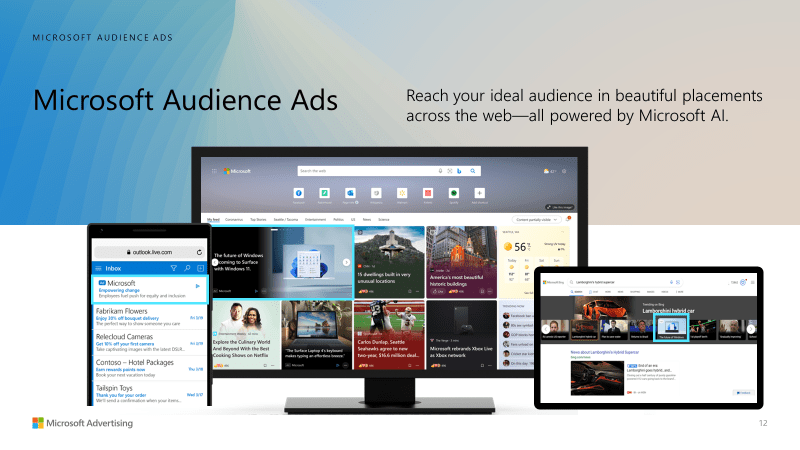
One of the areas where Microsoft Advertising differs most from Google is in its Audience capabilities. Through the Microsoft Audience Network, advertisers can extend reach beyond search into placements across Microsoft-owned and partner sites, creating opportunities to influence users earlier in their journey.
However, Audience campaigns are most effective when they are given a clear role rather than treated as a direct extension of Search. They can support awareness, reinforce messaging through remarketing, and maintain visibility in periods where search demand is limited. When aligned correctly, they help bridge the gap between discovery and conversion.
The focus here isn’t on achieving perfect performance immediately, but on understanding how Audience activity complements Search. When used intentionally, it can enhance overall account performance rather than operate as a disconnected channel.
Avoid Doubling Your Workload
Running Microsoft Advertising alongside Google shouldn’t feel like doubling your workload. If it does, it’s often a sign that too much time is being spent on low-impact changes, or that optimisation is being driven by habit rather than performance signals.
Because Microsoft operates at a different scale, not every campaign requires constant attention. Many elements of the account can be left to run with periodic review rather than continuous adjustment. This doesn’t mean neglecting the platform, but rather managing it proportionately based on where it is actually delivering value.
Microsoft performs best when it’s given the space to operate without excessive intervention, allowing efficiency to stabilise and performance trends to become clearer over time.
How Tools Help With Prioritisation
One of the biggest challenges when running multiple platforms is knowing where attention will have the greatest impact. With limited time and resources, focusing on the wrong areas can lead to diminishing returns.
Platforms like Adzooma help address this by bringing Microsoft and Google performance into a single view, making it easier to compare efficiency, identify opportunities, and understand how each channel contributes to overall results. By highlighting sustained trends rather than short-term fluctuations, they help teams prioritise actions that genuinely move performance forward, rather than reacting to every change.
This kind of visibility makes it easier to invest time where it matters, and step back where it doesn’t.
Final Thought
Running Microsoft Advertising alongside Google isn’t about copying what already works. It’s about understanding where the platforms differ and managing each accordingly. That means focusing on covering the right intent, prioritising efficiency over scale, and making fewer, more deliberate optimisation decisions.
When Microsoft is given a clear role and managed with proportionate effort, it often becomes a valuable, low-maintenance contributor rather than an additional channel to manage aggressively. Sometimes, the most effective optimisation isn’t doing more. It’s knowing what actually deserves your attention first.
Want to manage your Google Ads and Microsoft Ads in one place? Adzooma makes it easy to manage and optimise all of your campaigns in one platform. Sign up free today!